Crown vs Veneer: When Are They Used?
All About Dental Treatments in Turkey
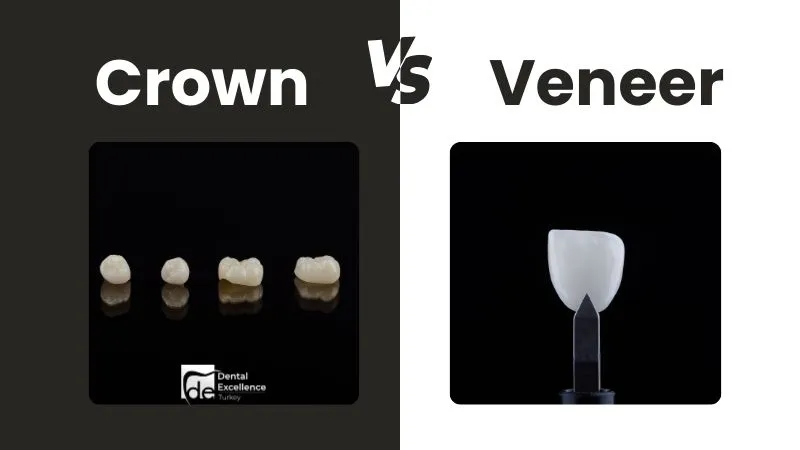
Veneers and crowns are dental treatments that patients often confuse. Both are methods applied to the surface of the tooth to improve its aesthetic appearance. However, their purposes, application methods, and reasons for being preferred are completely different. When choosing a treatment, the dentist considers how strong the tooth is, how it withstands chewing forces, and whether the goal is protection or simply to improve appearance.
A thorough examination is necessary before making the right decision. Tooth enamel thickness, the presence of cracks, old fillings, occlusion, the presence of decay, and gum health are all evaluated together. Only after this consultation can it be determined which treatment will be safe in the long term.
Dental crown
A dental crown is a restoration that completely covers the tooth after its damaged or decayed parts have been removed. In a sense, it acts as a protective cover and cap for the tooth. We prefer crowns in cases where the tooth structure is severely weakened and in conjunction with root canal treatment. This is because these teeth are no longer able to withstand biting forces on their own.
It is generally used after large fillings, on teeth that have undergone root canal treatment, or in cases of severe wear or fractures. If a significant amount of healthy tooth structure has been lost, simply covering the front surface is not sufficient. The tooth must be supported from all sides.
Some patients avoid getting crowns. However, in most cases, a crown is the only way to keep that tooth in the mouth. If a crown is not placed, many weakened teeth will eventually need to be extracted. While dental implants may be a solution in such cases, preventive dentistry aims to preserve the natural teeth.
When placing a crown, the tooth must be prepared. For this reason, the tooth is carefully reduced in size to make room for the crown material. Then, a dental adhesive (luting cement) is used to ensure the crown is securely fixed in place. Finally, the crown is fitted. Thus, the dental crown absorbs chewing forces and transmits them evenly to the root, reducing the risk of fracture. Crowns improve the tooth aesthetically and functionally and extend the life of the natural tooth.
Today, the ceramic and zirconia materials used for dental crowns are both highly durable and mimic natural enamel. When properly planned, patients can chew comfortably again and use their teeth without discomfort. In addition, by choosing a tooth shade that matches their natural teeth, they can smile with confidence.
Dental veneer
Veneers are thin ceramic layers bonded only to the front surface of the tooth. Unlike crowns, we prefer veneers when the tooth is healthy but the patient is dissatisfied with its appearance.
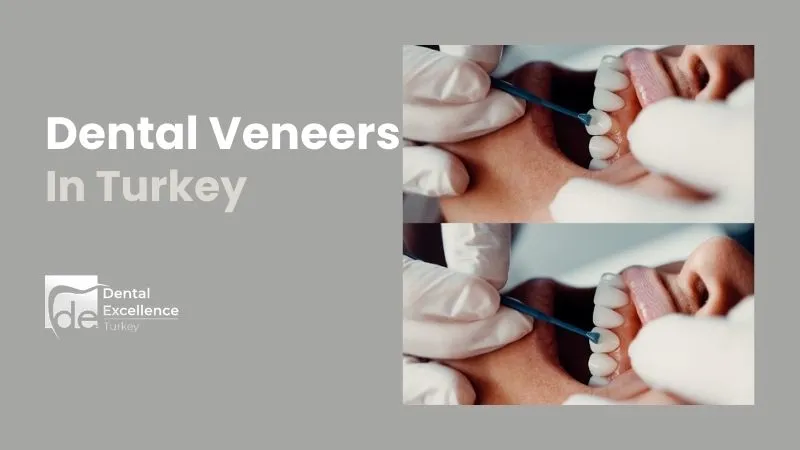
Discolourations, stains that cannot be removed by whitening, minor shape irregularities, gaps, or slight imperfections on the enamel surface are covered by this treatment. The teeth and gums to be covered must be healthy.
Veneers are not used to strengthen weakened teeth like crowns. They are not suitable for repairing deep fractures or compensating for large material loss. Their purpose is aesthetic improvement, and during this process, maximum respect is shown for healthy enamel tissue. If the defects in the teeth are very minor, laminate veneers or non-prep veneers may be preferred. If there are more colour changes and defects, restorations such as Emax veneers may also be preferred.
Dental veneers integrate with the enamel thanks to proper design and high-quality adhesives. They reflect light like natural teeth and provide a natural appearance thanks to their personalised design. Dental veneers are thin and therefore not as resistant to heavy biting forces as crowns. For this reason, they are frequently preferred, especially for anterior region aesthetics.
During veneer preparation, a millimetre-thin layer is removed from the tooth, sometimes only roughening the surface. This is because our goal is not to reduce the tooth size but to preserve the existing healthy structure. At the same time, this rough surface ensures better adhesion of the veneer. A dental adhesive is then applied. The veneers are placed. Minor adjustments are made if necessary. Finally, polishing is performed.
When are crowns and veneers chosen?
Crowns vs. veneers: When choosing between the two, the function of the tooth and which teeth will receive treatment are evaluated first. If the tooth has lost significant structure, contains large fillings, or is exposed to high chewing forces, a crown is the safer option. This is because crowns are strong enough to protect the tooth. If a veneer is placed on such a tooth, the veneer cannot withstand this load.
If the tooth is strong but has cracks, chips, or minor damage, veneer treatment can restore the teeth without damaging healthy tissue.
Occlusal analysis is also very important. Patients who grind or clench their teeth apply very high forces to restorations. In these cases, crowns may offer a more durable solution. Zirconia or Emax crowns can also be applied to front teeth.
The patient’s age, enamel thickness, and long-term expectations also influence the decision. In younger patients, a minimally invasive approach is preferred whenever possible. The fundamental principle in dentistry is to preserve the tissue first and then ensure aesthetics. The goal is to ensure that the tooth remains healthy, stable, and functional for years to come. A crown or veneer carried out with the correct indication does not just change your smile. It also ensures that the tooth can be used without problems for many years.
This blog was written to inform you about crowns vs. veneers. Please contact us for more information about your treatment.


START YOUR JOURNEY
Tell our specialist dentists about your teeth and get a free treatment plan.