
August 27, 2026
People in Turkey who are considering having veneers fitted often spend a great deal of time choosing the colour. However, veneer shape is just as important as the colour. The shape of the veneers determines whether your smile will appear soft or more defined, how well the teeth will harmonise with your face, and whether the result will feel like it truly belongs to you.
There is no single answer to the question, “What is the best veneer shape for my face?” A shape that suits one person may look too broad, too short or too uniform on someone else. Facial proportions matter, but so do your lips, gums, natural teeth and bite. Your own idea of an attractive smile matters as well. This veneer shape guide takes you through those decisions without reducing them to a face-shape formula.
Which veneer shape should you choose in Antalya?
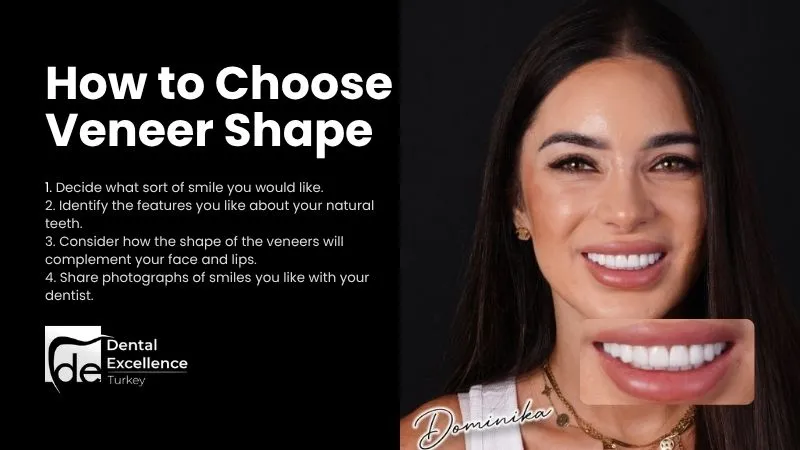
- Decide what sort of smile you would like.
- Identify the features you like about your natural teeth.
- Consider how the shape of the veneers will complement your face and lips.
- Share photographs of smiles you like with your dentist.
- Compare different veneer shapes on your own smile before treatment.
- Consider your dentist’s recommendations based on your face, teeth and bite.
You may be unsure which type of veneer would suit you best. You can share the smiles you like and the look you’re after with the Dental Excellence Turkey dentist. The dentist will help you decide by assessing the options in relation to your face and your natural teeth.
Different veneer shapes and how they change a smile
Descriptions vary from one dental laboratory to another. In practice, most different veneer shapes are variations of square, rounded, soft-square or tapered teeth. These are not four moulds from which a dentist simply chooses. Even within one category, a few small adjustments can alter the overall effect and create a more personalised, natural look.
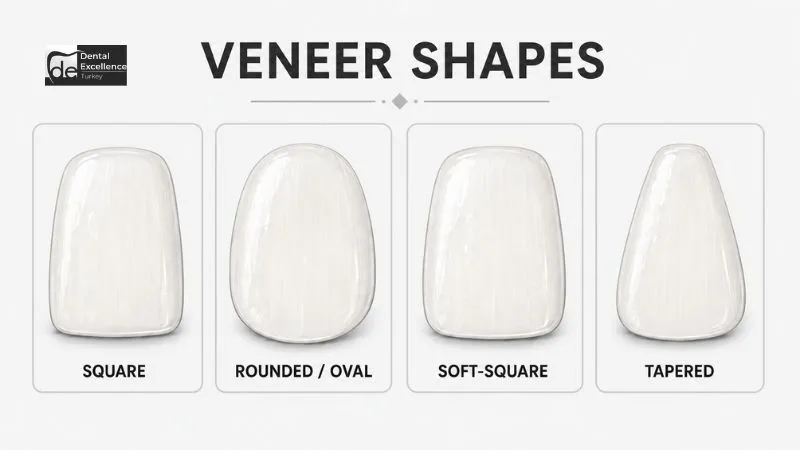
1. Square veneers
Square veneers have straighter sides and clearer angles at their biting edges. They tend to give the smile more structure. If they are made very broad, with identical corners on every tooth, the result can look heavy. Slightly easing the corners often retains the definition without making the smile appear rigid.
2. Rounded or oval veneers
Rounded veneers have curved edges and gentler corners. Many people associate them with a softer appearance.
3. Soft-square veneers
This design sits between the first two. The sides remain fairly straight, but the corners are softened. Soft-square veneers can provide a clean outline without looking sharply angular. Dentists can also adapt the design by giving the central incisors more presence and making the lateral incisors a little lighter.
4. Tapered veneers
With tapered veneers, the tooth becomes narrower as it approaches the gum line. This shape can create a more elegant appearance. However, the areas where the teeth meet near the gum line must be carefully planned. A veneer shape that tapers too sharply can make the gaps—known as ‘black triangles’—more visible, particularly in people with receding gums.
These basic names do not tell the full story. Tooth shapes for veneers also depend on incisor length, visible width, corner position, surface contour and the prominence of the canine teeth. Those details are often what separate a personal design from a standard-looking set of veneers.
If you’re looking to buy affordable veneers from international brands in Antalya, please contact us.
How does face shape influence veneer design?
A Turkish dentist normally looks at the face from the front and in profile. The jawline, cheek width and overall facial length provide context. Attention then moves closer to the smile: the way the lips curve and move, how much tooth is visible at rest, the gum display and whether the dental centre line sits comfortably within the face.
One feature may be balanced by another. Soft edges can reduce the severity of a strongly angular outline. A little more vertical emphasis may give definition to a short, broad face. Sometimes the most convincing result follows the natural facial lines rather than contrasting with them.
Best veneer shape for a round face
A round face often has softer contours and a similar impression of width and length. Slightly longer front teeth can introduce vertical emphasis. Soft-square or gently tapered shapes may add definition while keeping the smile natural.
Lip position can overturn the general advice. If plenty of upper tooth already shows when the lips are relaxed, adding more length may not be suitable. This is why the best veneer shape for a round face cannot be selected from a face photograph alone.
Veneer shapes for square and angular faces
On a square face, sharply angled and very wide veneers can reinforce an already strong outline. Some patients like that result. Others prefer rounded corners or a soft-square design to make the smile feel less severe.
There is no need to remove every straight line. Defined central incisors may sit well with a strong jaw, while softer lateral incisors provide a natural transition towards the canines. The outcome depends on the combination, not on making six or ten teeth share exactly the same outline.
Feminine and masculine veneer shapes
You may hear softer, narrower and more rounded teeth described as feminine veneer shapes. A slightly greater difference in length between the central and lateral incisors may also be used to create this effect.
Masculine veneer shapes are usually described as broader and straighter, with more obvious angles and stronger canines. These terms can help a patient communicate a preference, but they are not biological rules.
What makes veneer shapes look natural?
Natural-looking veneer shapes rarely come from making every visible tooth identical. Central incisors naturally lead the smile. Lateral incisors tend to be smaller and may sit slightly higher at the edge. Canines change the direction of the dental arch and have their own contour. Keeping some of that hierarchy helps the smile avoid a flat, repeated appearance.
Then there is the surface itself. Natural enamel is not a featureless sheet. Subtle texture and contour affect the way light moves across a tooth. Turkish dentist uses these details to make a veneer appear slimmer or fuller without making a large change to its actual width. Translucency near the edge can prevent a pale veneer from looking dense or opaque.
Colour still plays a part. A very bright, uniform shade draws attention to the outline of every tooth. If the aim is a quiet, natural result, shape, surface texture and shade need to be planned as one design rather than three separate choices.
What is the 4-8-10 rule for veneers?
4-8-10 rule for veneers is a simple planning approach that explains how many teeth can be treated with veneers. The numbers here refer to covering 4, 8 or 10 teeth in the upper jaw with veneers.
- 4 veneers may be considered if the treatment is limited to the front four teeth.
- 8 veneers are planned to create a more balanced transition if the canines and the teeth next to them are also visible when smiling.
- 10 veneers are considered for people with a wide smile where the back teeth are also visible.
This does not mean that everyone must necessarily have 4, 8 or 10 veneers fitted. Whilst six veneers may be sufficient for some people, a different number may be planned. The decision is based on how many teeth are visible when smiling, as well as the colour and strength of the natural teeth. The aim is to prevent any noticeable difference in colour or shape between the veneered teeth and the natural teeth.
Frequently asked questions
Can you choose the shape of veneers in Turkey?
Yes. As Turkey veneers are custom-made for each tooth, you can be involved in the decision-making process regarding their length, width, outline and edge shape. Whether you wish to preserve the natural character of your teeth, make worn teeth appear fuller, or achieve a more striking smile, you can discuss your ideas with your dentist.
That does not mean every requested shape will work. Your dentist must check how much space is available and how the upper and lower teeth meet. Gum levels and the condition of the enamel also affect the plan. An attractive design still needs to function when you speak, bite and chew.
Do veneers have to match the shape of your face?
No. Face shape can guide smile planning, but it is not a strict template for tooth shape. Existing teeth, facial proportions, lips, gum levels and the bite should be considered together.